For many visitors, the workshop begins with curiosity.
How does waste plant fibre or shredded fabric become a sheet of paper?
The answer unfolds one step at a time.
For Arun, however, Auroville Papers is more than a workplace. It is a place he has grown with—personally and professionally—a place that has continued to blossom through unexpected turns and changing times.
Born in the neighbouring village of Edayanchavadi, Arun spent his childhood studying in Auroville. At nineteen, he joined Auroville Papers, learning the craft of handmade paper from the inside out. Years later, he stepped away to gain experience elsewhere before returning to take on the responsibility of managing the unit.
“I’ve been here from my childhood,” he says. “I’ve seen how Auroville was growing, and how the businesses started here.”
For Arun, returning is a way of giving back to the community, continuing a story that had begun decades earlier and given him his first chance.
More Than Handmade Paper
From the beginning, Auroville Papers has been about more than creating beautiful stationery or handcrafted products. It was built around a simple idea: create meaningful work for the people living in the surrounding villages.
“The aim,” Arun explains, “was to give more work to the surrounding village people. We didn’t want too many machines. We wanted everything to be done manually, and we wanted to give people jobs in this area.”
That philosophy continues today. While much of the world has shifted towards automation, the rhythm inside Auroville Papers is still guided by skilled hands. Every sheet carries the patience, precision, and experience of the people who make it.
The process may be slower, but that’s precisely where its value lies.
Paper Without Trees
Ask most people where paper comes from, and the answer is almost always the same: trees.
One of the greatest surprises for visitors is discovering that handmade paper at Auroville Papers follows a completely different path.
“Many adults don’t know,” Arun says. “What they know is that most paper is made from trees.”
Instead, the team works with cotton fibres, plant fibres, and certain agricultural waste that can be transformed into paper. Banana fibres, pineapple fibres, and other natural fibres become the starting point for a lot of the products.
It changes the way people think about paper—not as something extracted from forests, but as a material that can emerge from nature and natural byproducts in many different forms.
Nature Leaves Its Signature
Walk through Auroville Papers and you’ll quickly notice that no two sheets look exactly alike.
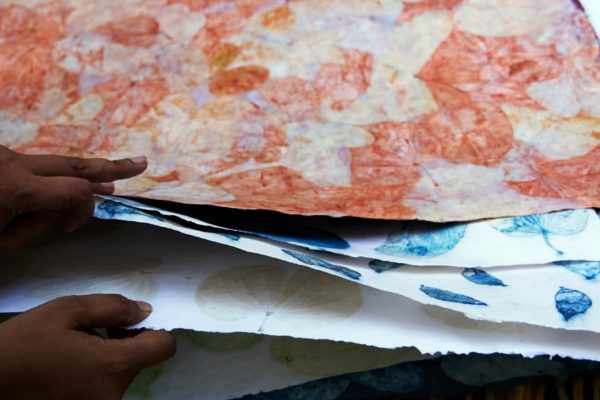
Some carry delicate impressions of leaves. Others are coloured with natural tones drawn from turmeric, fruits, or vegetables. Depending on the needs of a project, textile colours may also be used, but wherever possible, natural pigments become part of the process.
“We use turmeric and fruit or vegetable colours,” Arun explains. “They’re natural.”
Even the leaves become collaborators.
Collected from the landscape around Auroville, each one leaves behind its own texture and pattern when pressed into the paper.
“Nature gives its own designs for our paper,” he says.
It is this quiet partnership with nature that makes every sheet as unique as nature’s beauty. Each carries its own character, shaped as much by the seasons as by the hands that created it.
“Nature gives its own designs for our paper.”
Learning Through Making
Participants learn how to prepare pulp, pull handmade sheets, experiment with colours, and understand the small details that transform raw fibres into finished paper. Rather than simply observing the process, they become part of it.
Children are often the most fascinated.
“They’re very happy to learn paper making,” Arun says. “They have no idea how paper is made.”
Yet the surprise isn’t limited to younger visitors. Adults, too, leave with a completely different understanding of a material they use every day without a second thought.
A Tradition of Experimentation
Experimentation has always been woven into the story of Auroville Papers.
Over the years, the team has explored different natural fibres, textures, colours, and botanical impressions, discovering new possibilities hidden within everyday materials. What begins as cotton, banana fibre, or a fallen leaf gradually transforms into paper that is tactile, expressive, and entirely unique.
It is a craft where mistakes often become the craft, and where every new material offers another opportunity to learn and create.
That spirit reflects Auroville itself—a place where creativity, sustainability, and practical innovation are encouraged to grow together.
Every Sheet Has a Story
In an age of mass production, Auroville Papers offers something increasingly rare: objects made slowly, thoughtfully, and by hand.
Each sheet represents more than a finished product. It carries the imprint of leaves gathered from the landscape, fibres sourced from plants, the knowledge passed between artisans, and the hands that patiently shape it into something new.
No two sheets are ever identical.
And perhaps that’s the beauty of handmade paper.
Like the people who make it, every sheet tells its own story.
“Let beauty be your constant ideal.
The beauty of the soul,
The beauty of sentiments,
The beauty of thoughts,
The beauty of the action,
The beauty in the work,
so that nothing comes out of your hands which is not an expression of pure and harmonious beauty.”
— The Mother (Mirra Alfassa)
Discover the craft of handmade paper through an Auroville Papers’ workshop with AGP Workshops.
Learn how natural fibres become paper, create your own handmade sheets, and experience a process where sustainability, creativity, and craftsmanship come together—one sheet at a time.